Pet Export Indonesia: Documents and Departure Steps
July 18, 2026
Taking your pet out of Indonesia can feel deceptively simple: one pet, one flight, one new home. In practice, the departure side involves a connected set of veterinary records, destination requirements, quarantine coordination, and live-animal cargo arrangements. A missing detail in one part of that chain can affect the rest.
This guide explains pet export from Indonesia from the origin-side perspective. It is designed for families relocating, professionals moving for work, and owners arranging for a pet to follow them overseas. Requirements change by route and date, so confirm the current plan before making final commitments.
What pet export from Indonesia means
When a dog or cat leaves Indonesia for another country, the trip is generally treated as an export process even when it is a single family pet travelling with its owner. The Indonesian preparation is only one half of the journey; the destination may also require an import permit, a particular certificate format, or additional health evidence.
That is why the question is not only “Can my pet fly?” A better starting point is whether the pet’s identity, health history, departure paperwork, airline handling, and destination acceptance can line up on the same travel date. For route-specific planning, review the available options through the pet relocation route hub.
Core documents prepared on the Indonesian side
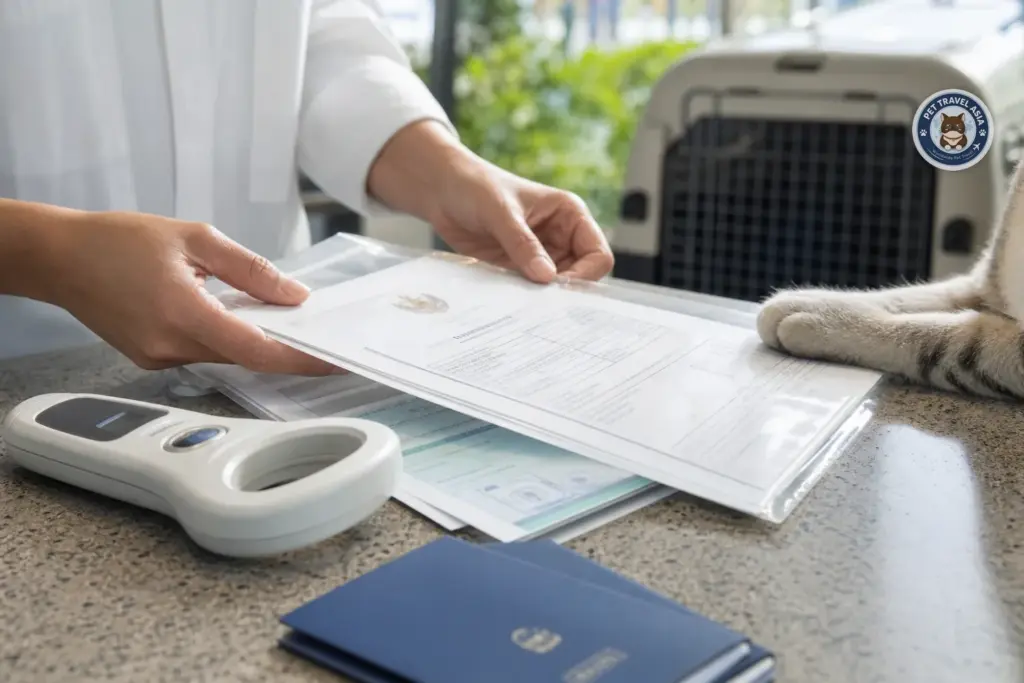
The exact file varies by destination, but a typical preparation pack starts with proof of ownership, a readable microchip record, rabies and core-vaccine records, and a health certificate issued by a veterinarian. Depending on the route, an import permit from the destination and Indonesian quarantine documents may also be needed.
- Identity and microchip record: the reference number needs to match across the vaccination record, certificate, and booking paperwork.
- Vaccination history: keep the original dates and provider details available for review.
- Veterinary health certificate: this is usually prepared close to travel, so its timing must match the route plan.
- Destination approval: some routes require permission or a prescribed document format before departure can be confirmed.
- Quarantine paperwork: it may be required when a pet leaves Indonesia, depending on the route and current conditions.
Indonesian animal quarantine is handled by the Badan Karantina Indonesia. Since document timing and inspections need to be coordinated, it helps to begin with a quarantine-assistance plan rather than treating the paperwork as a final-day task.
Why sequence and timing matter
Pet export Indonesia preparation works like a chain. A common order is microchip identification, vaccination records, a rabies titer test where the destination calls for one, a health certificate, quarantine documentation, and then a live-animal cargo booking that fits the completed paperwork. The correct order depends on the destination, but reversing it can create expensive rework.
| Order | Step | Planning note |
|---|---|---|
| 1 | Microchip identification | The reference number has to match every document that follows. |
| 2 | Vaccination records | Keep the original dates and provider details available for review. |
| 3 | Rabies titer test | Only where the destination calls for one. This step usually sets the longest lead time. |
| 4 | Veterinary health certificate | Prepared close to travel, so its validity window has to match the flight date. |
| 5 | Quarantine documentation | May apply on departure depending on the route and current conditions. |
| 6 | Live-animal cargo booking | Confirm only after the steps above are complete and the route has been checked. |
For a simpler route, starting around six to eight weeks before travel is a sensible planning baseline. Routes with stricter requirements can need more lead time because testing, permits, or quarantine arrangements may take longer. Do not treat that baseline as a universal rule: confirm it for your specific origin, destination, pet, and flight date.
Short document validity windows are a practical risk. A certificate prepared too early may no longer be usable at departure, while a late appointment can leave insufficient time for review. Use the international pet relocation checklist to map tasks backward from the intended flight.
Quarantine checks and the departure point
Export quarantine requirements can apply for certain destinations. The process and any holding period depend on the origin, destination, animal type, health status, and documents available, so it should never be assumed to be identical from one route to another.
Jakarta, Surabaya, Bali, Makassar, and Medan are often important departure points because they connect to airports, ports, or active domestic routes. The nearest city is not always the best departure point: airline routing, cargo facilities, and the availability of relevant officers all matter. Confirm the operational sequence before your pet is taken to the terminal.
At this stage, details must agree: the animal’s microchip number, the paperwork, the crate label, and the cargo booking. A calm handover is easier when the inspection and airline timeline have been coordinated in advance.
The destination country sets the wider timeline
Indonesia-side documents do not replace the rules at destination. The receiving country may require an import permit, a titer result, specific wording on a certificate, or a particular crate and arrival process. Those conditions can determine when the Indonesian steps need to start.
A secure travel crate is part of that preparation, not an afterthought. Review the IATA crate guide before choosing a crate or measuring your pet. If a rabies titer is relevant to your route, this overview of rabies titer testing can help you understand why it needs to be planned early.
Common mistakes to avoid
- Booking a flight before the live-animal route and required paperwork have been checked.
- Having a certificate issued too early and discovering it has expired before travel.
- Using inconsistent microchip information across veterinary and transport documents.
- Assuming a requirement from another country or an earlier journey still applies today.
- Leaving crate selection until cargo arrangements are already underway.
The most useful safeguard is one shared timeline for the owner, veterinarian, destination process, quarantine coordination, and carrier. Reconfirm the route before the final date is locked.
FAQ
How early should I start exporting a pet from Indonesia?
For simpler routes, begin planning around six to eight weeks before travel. Start earlier for routes that may involve testing, permits, or extra quarantine arrangements, and confirm the current timeline for your destination.
Does every pet leaving Indonesia need quarantine?
Not necessarily. Quarantine can apply to exports for certain destinations, and the requirement depends on factors including the route, animal type, health status, and documentation. Confirm the current requirement for the planned departure.
Can I arrange the cargo booking before the documents are ready?
You can discuss options early, but do not treat a booking as final until the live-animal route and paperwork sequence have been checked. The booking must align with the documents and the pet’s accepted travel arrangement.
What is the role of a microchip?
The microchip helps connect the pet to its records. Its number should be consistent across vaccination records, health certificates, quarantine documents, and transport paperwork.
Preparing a pet for export is easier when one team can coordinate veterinary records, document timing, and the departure plan. Contact Pet Travel Asia to discuss documentation support and a route-specific preparation plan for your pet.