Importing Dogs to Thailand: DLD Permit, Vaccines, Arrival
October 31, 2026
Bringing a dog into Thailand usually starts with one reassuring line: pets that meet the requirements are not quarantined. That is true, but it hides how much has to line up before your dog lands. The import permit comes from Thailand’s Department of Livestock Development (DLD), the vaccines are checked against Thai timing rules, the health certificate comes from your departure country, and the airline has its own view on your dog’s size and breed.
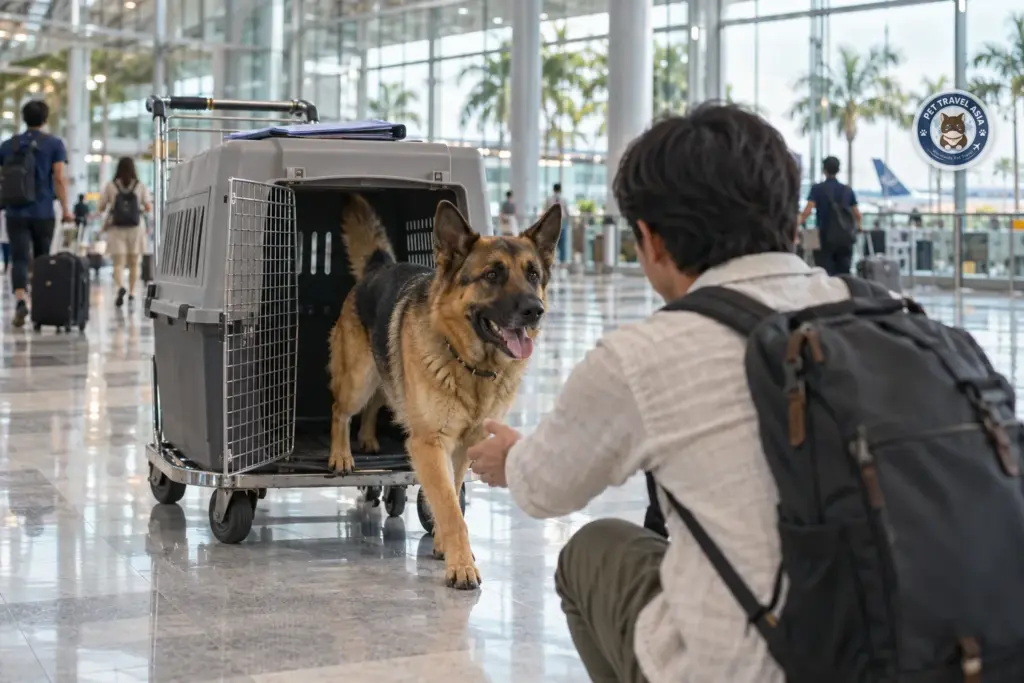
Dogs bring a few problems cats rarely do. A large dog usually needs a big crate and often has to fly as cargo. A snub-nosed breed may be refused by some airlines altogether. And arriving at Bangkok in the heat of the afternoon is a different experience for a German Shepherd than for a small cat in a cabin carrier.
This guide covers the dog-specific side of an import into Thailand from any origin: the permit request, the vaccines, crate and airline questions, and what happens at Suvarnabhumi (BKK). It does not give fees or fixed timelines, because those depend on your route and can change.
What a dog needs to enter Thailand
Our Thailand pet import overview sums up the entry side as three core items: a DLD import permit, a microchip and a rabies certificate. In practice, a dog’s file usually holds a few more pieces, each owned by a different party.
| Item | Who handles it | What to watch for a dog |
|---|---|---|
| Import permit | DLD animal quarantine station | Requested before travel, using your dog’s details and flight plan |
| Microchip | Your vet at origin | The number must read and match every document |
| Rabies and other vaccines | Your vet at origin | Recorded in English, with dates that fit Thai timing rules |
| Official health certificate | Veterinary authority of the exporting country | Issued close to departure, so timed around a confirmed flight |
| Flight booking | The airline or its cargo team | Crate size, breed limits and whether the dog flies as cargo |
| Arrival inspection | Animal quarantine station at the Thai airport | Document check and a look at the dog when it lands |
Requesting the DLD import permit
The Thai government’s own pet guidance describes the permit as an email request to the animal quarantine station, sent at least 7 working days before travel. The request includes an application form (form R1/1), a copy of the passenger’s passport, a photo of the pet, the flight itinerary, the vaccination record in English and the microchip certificate. The guidance then allows at least 3 working days for a veterinary officer to review it, and the approved permit comes back by email.
Those are minimums, not a plan. If the officer needs more information, the review takes longer, and the permit has to be in hand before your vet at origin can finalise the health certificate. Send the permit request as soon as your dog’s microchip and vaccine records are complete, rather than waiting until the flight is days away. Our Thailand pages suggest starting the Thai side 3 to 6 weeks ahead, and the departure country often needs longer.
Because the request includes your itinerary, a later change of flight can mean updating the permit details too. Ask how a date change is handled before you submit, not after.
Rabies and the other vaccines dogs need
For dogs, the Thai guidance lists rabies plus the combined DHP/L vaccines: distemper, hepatitis, parvovirus and leptospirosis. Cats have a shorter list, which is one reason a dog’s file tends to need more checking.
The timing matters as much as the vaccine itself. The exact window between vaccination and travel is written into the health certificate your departure country issues for Thailand, and it can differ by origin. On the US route, for example, the current certificate asks for vaccines given at least 21 days before departure and accepts a negative leptospirosis test in place of a valid leptospirosis vaccine. Our US to Thailand guide walks through that version in detail. Do not assume the same numbers apply from every country; ask your vet to check the current certificate for your origin when you start.
If a booster is due in the weeks before the move, give it early. A vaccine given too close to the flight is one of the most common reasons a dog’s travel date has to move.
Large dogs and snub-nosed breeds: the airline question
The DLD guidance we reference does not set out breed bans, and for most families the breed question comes from the airline instead. Our Thailand relocation page notes that many airlines only carry larger dogs as cargo on Bangkok routes, and that snub-nosed breeds face extra restrictions. If your dog is a large guarding breed, ask both the airline and DLD before you plan around a particular flight.
For a big dog, the crate drives most of the planning. It has to let the dog stand, turn and lie down naturally, and it has to meet the airline’s live-animal rules. A crate that looks fine at home can be refused at check-in if the dog’s ears touch the roof. Measure your dog standing, and let it get used to the crate weeks before the trip.
Brachycephalic dogs, such as pugs, French bulldogs and boxers, are a separate case. Some carriers will not take them in the hold at all, and others limit them in hot months. Our guide to cargo, cabin and checked baggage explains how the three options differ, which helps when an airline offers only one of them.
Arriving at Suvarnabhumi with a dog
Most dogs entering Thailand land at Bangkok Suvarnabhumi (BKK). Where the inspection happens depends on how the dog travelled. According to the Thai guidance, a dog that flies with you is inspected by the animal quarantine station in the arrivals area, which runs 24 hours. A dog that arrives as air cargo goes to the quarantine office at the cargo terminal, which the same guidance lists with weekday office hours.
That difference is easy to miss. If your large dog flies as cargo and lands late on a Friday, collection may not be as quick as you hoped. When choosing a flight, check the arrival day and time against the cargo office’s hours, and ask your coordinator how a late or weekend landing would be handled. Keep the original passport, the original vaccination book, the original health certificate and a printed copy of the permit together for the inspection.
Bangkok’s heat is the other arrival factor. A long wait on a hot cargo apron is hard on any dog, and harder on heavy-coated or snub-nosed breeds. Morning or evening arrivals are often easier, subject to what the airline actually flies.
Your starting country shapes the rest
Everything above is the Thai side. The longer part of the job is often in the country your dog is leaving: export rules, the official health certificate, endorsement and, for some routes, extra tests. Our general pet relocation to Thailand guide explains how to run the two calendars in parallel, and the US route has its own guide linked above. For a first estimate of cost by route and dog size, try the cost calculator.
Frequently asked questions
Will my dog be quarantined in Thailand?
Our Thailand overview describes no quarantine for pets that fully meet the requirements. Your dog is still inspected on arrival, and DLD decides each case, so a missing or mismatched document can change the outcome.
How far ahead should I request the import permit?
The Thai guidance asks for the request at least 7 working days before travel, with at least 3 working days for review. Treat those as minimums and start earlier, especially if your departure country has a longer process.
Can a large dog fly in the cabin to Bangkok?
Usually not. Cabin space is limited to small pets on most airlines, and larger dogs generally fly as cargo. Confirm the options for your exact route and dog before you book.
Are any dog breeds banned from entering Thailand?
The DLD guidance we use does not list breed bans, but airlines often restrict snub-nosed and some large breeds. Ask DLD and the airline about your dog’s breed early, since rules can change.
If you are planning to bring your dog to Thailand, send us your route and your dog’s details. We can review the permit timing, vaccines, crate and flight options together and tell you what needs confirming first.