Pet Cargo vs Cabin vs Checked Baggage: Which Applies?
October 29, 2026
When owners first look into flying a pet, the three terms that keep coming up are cargo, cabin and checked baggage. They sound like seat classes you can pick from. In practice, you rarely get to choose freely. Your pet’s size and breed, the airline’s rules for each flight, and the destination’s entry conditions usually settle the question before you do.
This guide explains what each option actually means on travel day, which one tends to apply on routes into Indonesia, Singapore, Malaysia, Thailand, the Philippines and Vietnam, and how to work out your own answer in the right order. It does not compare fares, because pricing depends on the route, the crate and the season.
Cargo, cabin and checked baggage: the short answer
All three put your pet on a plane, but they are handled by different parts of the airline and come with different rules.
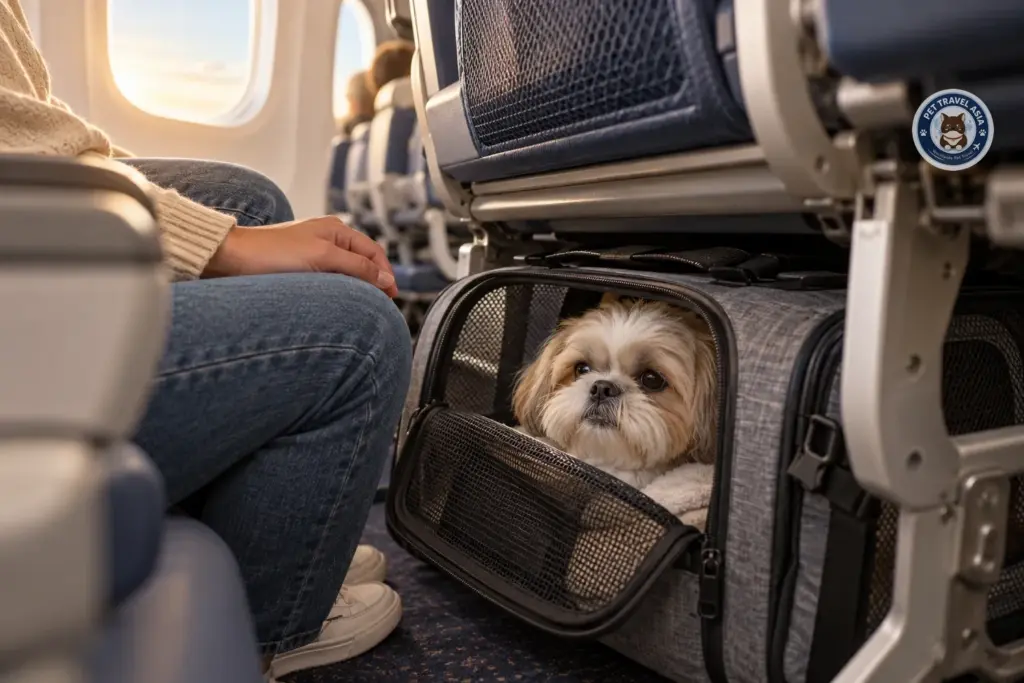
- In-cabin: a small pet travels in a soft carrier under the seat in front of a passenger. It is booked as an extra on a passenger ticket.
- Checked baggage (accompanied): your pet flies in the temperature-controlled hold on the same flight as you, in a crate that is checked in at the passenger counter.
- Manifest cargo: your pet travels as live-animal cargo under its own air waybill, booked and handed over through the cargo terminal. You do not need to be on the same flight.
Accompanied baggage and manifest cargo both mean the aircraft hold. The difference is how the booking, check-in and arrival clearance work, and that difference matters a lot on international moves.
How the three options compare
| In-cabin | Checked baggage | Manifest cargo | |
|---|---|---|---|
| Where the pet rides | Under the seat, in the cabin | Aircraft hold | Aircraft hold |
| Owner on the same flight | Yes, required | Yes, required | Not required |
| Booked through | Passenger reservation | Passenger reservation | Airline cargo, with an air waybill |
| Check-in point | Passenger counter | Passenger counter | Cargo terminal |
| Usually suits | Small cats and dogs within the airline’s weight and carrier limits | Pets too big for the cabin, on routes where the airline offers it | Larger pets, unaccompanied pets, and destinations that require it |
| Main thing to confirm | Cabin approval on every leg | Whether every leg and the destination accept it | Live-animal acceptance, crate and documents for the route |
Why many moves into Asia end up in cargo
On international relocations into the region, manifest cargo is often the path that is left once the rules are lined up. There are three common reasons.
First, some destinations set the path themselves. Singapore is a useful example: dogs and cats arriving at Changi are usually handled as manifested cargo, moved from the aircraft to the AVS quarantine station at the Changi Airfreight Centre and cleared through an AVS-recognised agent, so cabin and checked-baggage arrivals are often not a practical option there. Other countries handle arrivals differently, and rules are updated, so check the current conditions for your destination rather than assuming one country’s rule applies to the next. Our Singapore relocation page covers that route in more detail.
Second, airlines decide per flight. A carrier may accept pets in the cabin on a domestic sector but not on an international one, or offer checked baggage on one leg and not on the connection. If any leg says no, the whole journey has to switch to a path every leg accepts.
Third, size rules out the cabin for most dogs. Cabin limits usually cover the pet and carrier together, and the carrier has to fit under a seat. Many airlines keep that combined weight well under 10 kg, though the exact figure varies by carrier and can change. A medium or large dog will almost always fly in the hold.
When in-cabin is realistic
Cabin travel is worth checking if your pet is a small cat or dog that fits comfortably in an airline-approved soft carrier, the destination accepts arrivals that way, and every flight on your routing allows pets in the cabin. Airlines also cap how many pets can be in the cabin per flight, so space can run out even when the rules allow it.
The cabin matters most for snub-nosed (brachycephalic) breeds such as French Bulldogs, Pugs and Persian cats. Many airlines restrict these breeds in the hold because of breathing and heat risks, which can leave the cabin as the only workable option. Our guide to flying a French Bulldog in the cabin goes through those rules in detail. Where the route and airline allow it, our VIP escort service puts a team member on the same flight with your pet in the cabin, after cabin approval is confirmed for every leg.
Checked baggage: the option that varies most
Checked baggage sounds like the simple middle ground, and on some routes it is. The catch is consistency. Fewer airlines offer it on international sectors than in the past, crate size limits for checked pets can be tighter than for cargo, and some destinations do not accept pets arriving this way at all. It also only works if you are on that exact flight.
Treat it as something to confirm, not something to plan around. If the airline, every connection and the destination all accept it, it can work well. If any one of them is unclear, plan for manifest cargo and treat checked baggage as a bonus.
What manifest cargo looks like in practice
With manifest cargo, your pet is booked as a live-animal shipment. The crate is handed over at the cargo terminal, documents are checked against the booking, and the pet is loaded under the airline’s live-animal procedures. On arrival, clearance happens through the cargo and quarantine process at the destination airport, not at the passenger baggage belt.
This path is the most predictable for international moves because it is built for animals that travel without their owners, and it does not depend on your own ticket. It also asks the most of the crate: it must meet IATA live-animal standards and fit your pet properly. Our air cargo service covers the booking, crate review and handover, and the CGK cargo guide shows what departure day looks like from Jakarta.
How to find out which one applies to you
Work through these questions in order. Each one can remove options before the next one matters.
- Destination: does the arrival country accept your pet in the cabin or as checked baggage, or does it expect manifest cargo?
- Your pet: what do your pet and carrier weigh together, and is the breed restricted in the hold on the airlines you are considering?
- The routing: does every leg, including connections, accept the same path on your travel date?
- You: will you be on the same flight, or does your pet need to travel separately?
Get the destination rule and the airline’s answer for every leg in writing before you buy a carrier, a crate or a passenger ticket. Our overview of airlines that carry pets from Indonesia is a useful next step once you know which path you need.
Frequently asked questions
Is cargo safe for pets?
Live-animal cargo travels in a pressurised, temperature-controlled part of the hold, and airlines have specific handling procedures for it. Risk depends on the pet’s health, breed, the crate, the weather and the routing, which is why snub-nosed breeds and long hot transits need extra review with your vet and the airline.
Can I take my pet in the cabin on an international flight to Asia?
Sometimes, for small pets on airlines and routes that allow it. The destination must also accept cabin arrivals. Arrivals into Singapore, for example, are usually handled as manifested cargo, so check your destination’s current rules first.
What is the difference between checked baggage and cargo if both use the hold?
Checked baggage is tied to your passenger ticket and checked in at the passenger counter, so you must be on the flight. Manifest cargo is a separate shipment booked through the airline’s cargo side, with its own documents and clearance at the destination cargo terminal.
My dog is too big for the cabin. Do I have to use cargo?
Not always. If the airline, every connection and the destination accept checked pets, accompanied baggage may be possible. On many international moves into the region, though, manifest cargo is the option that can be confirmed end to end.
Not sure which path fits your route?
Send us the origin, the destination and your pet’s breed, age and weight, and we will check which options hold for your dates. You can get a first estimate from our cost calculator or talk to our team directly.