Pet Export Singapore: AVS Licence Steps
August 29, 2026
Exporting a pet from Singapore can look straightforward until the flight date starts moving. A cargo space opens up, a veterinarian appointment changes, or a destination asks for one more check. The difficult part is often not finding a flight. It is keeping every Singapore-side document inside the right validity window when the plan changes.
For pet export from Singapore, the most useful starting point is a backwards schedule. Put the planned departure first, then line up cargo acceptance, veterinary work and the AVS export licence around it. That approach gives you room to check destination requirements without treating a flight reservation as the whole plan.
Prefer to hand the whole departure to one team? See our pet export service from Singapore, covering the AVS licence, vet timing, flight and arrival.
Pet export from Singapore starts with a window, not a ticket
An AVS export licence and an internationally recognised health certificate are central to the Singapore departure process. The AVS export licence is valid for 90 days. The health certificate has its own validity, set by the destination and the certificate type, and that is usually the tighter window. Requirements can change, and the destination country decides what it will accept.
Work backwards from the intended flight date so the final licence and health certificate remain valid at handover and arrival. This is especially important when airline cargo availability is limited or when the destination needs documents reviewed before departure.
Singapore’s export process is different from bringing a pet into Singapore. For an overview of the two-way hub and current source-side information, see our Singapore pet import and export guide. Keep destination-specific preparation separate from the Singapore departure checklist.
The Singapore-side papers to organise
The core departure papers are the AVS export licence and a health certificate. The exact supporting records depend on the destination, the pet and the airline, so they should be confirmed for the individual move rather than copied from another route. A microchip or vaccination history may matter to the receiving country, but this guide does not replace that country’s rules.
| Planning item | Why it matters | Who should confirm it |
|---|---|---|
| Destination requirements | They set the outer deadline and supporting records. | Destination authority and relocation team |
| AVS export licence | It is part of the Singapore-side export clearance. | AVS and documentation coordinator |
| Health certificate | Its validity must align with the planned movement. | Veterinarian and destination requirements |
| Airline cargo handover | It fixes the practical time for terminal acceptance. | Airline or local handling partner |
Keep a single working copy of names, microchip details, flight information and destination contacts. Small inconsistencies between documents can create avoidable questions at a late stage. Our pet travel documentation service can help coordinate the paperwork sequence with the broader move.
Book backwards from the validity window
Start with a realistic provisional departure date, not an irreversible promise. Confirm whether the destination has an import permit, inspection, laboratory or pre-arrival step that has to happen before the Singapore documents are issued. Then reserve an appropriate cargo option and fit the veterinary appointment into the remaining window.
- Confirm the destination’s current entry conditions and any approval milestones.
- Identify a flight and the required cargo acceptance timing.
- Schedule the veterinary work at a point that supports the document window.
- Arrange AVS export licence processing in the correct sequence.
- Recheck the complete file after the flight is confirmed and before terminal handover.
This sequence is a planning framework, not a substitute for official instructions. A route such as Singapore to Indonesia has its own receiving-country process, while Singapore to the Philippines needs a different destination review. Avoid assuming that a document accepted on one route will be accepted on another.
What happens on departure day
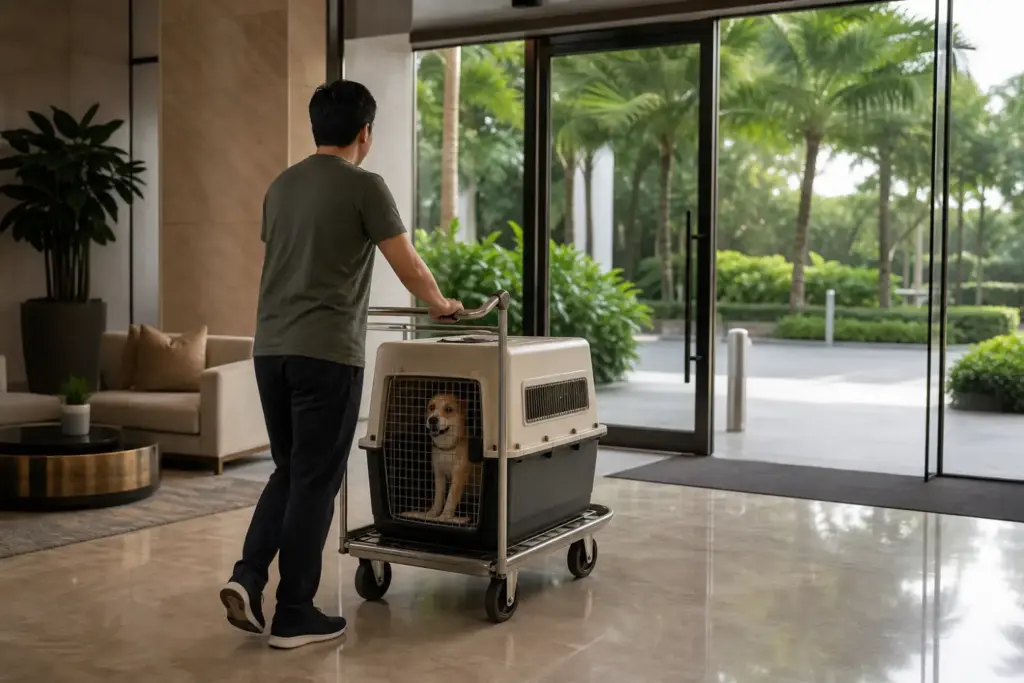
The airline handles the live-animal check-in, and any inspection depends on what the destination requires. The handover is easier when the documents, pet identification and crate details match the arranged shipment. Your handler or airline partner can advise on the arrival time and presentation process for the specific flight.
The travel crate also deserves early attention. It needs to suit the pet and airline handling requirements, while allowing the animal to stand, turn and rest comfortably. Use our IATA crate guide to prepare the crate well before departure, rather than introducing it on travel day.
Let the destination set the outer timeline
Singapore’s departure window is only one side of the move. The destination’s import rules, approvals and inspection availability establish the outer timeline, so confirm them first. As a contrast, entry into Singapore itself is category-based and has a separate licensing and planning process. Do not use those inbound rules to plan an outbound move.
For a regional comparison, our Thailand pet export guide explains why origin-country workflows cannot simply be swapped. Each authority, airline and destination combination needs a fresh check.
A realistic preparation rhythm from Singapore
Plan roughly 3 to 6 weeks ahead when leaving Singapore, and start earlier if the destination has longer lead times or the travel date is inflexible. This is an estimate, not a guarantee. Airline capacity, veterinary availability and destination approvals can all change the workable sequence.
If you are comparing budgets, keep the quote tied to the actual route, pet size and service scope. Our guide to international pet shipping costs explains the factors that usually shape the total without treating any single estimate as universal.
Frequently asked questions
How early should I start pet export from Singapore?
Start planning about 3 to 6 weeks before departure where possible, then work backward from the destination’s requirements. Begin earlier if approvals or a fixed travel date leave little flexibility.
Does an AVS export licence guarantee entry at the destination?
No. The AVS licence supports departure from Singapore, while the destination authority sets entry conditions. Confirm both sides before finalising the schedule.
Why does the document validity window matter?
The AVS export licence lasts 90 days, but the health certificate window is set by the destination and is often much shorter, so it decides when the vet visit should happen. If a document is outside the accepted window at the relevant checkpoint, the flight plan may need revision.
Can my pet travel in the cabin instead of as cargo?
That depends on the airline, pet, route and destination requirements. Ask the airline and your relocation coordinator to confirm the available option for your specific journey.
Ready to map the Singapore-side timing around your destination? Contact Pet Travel Asia to review the route, paperwork sequence and practical handover plan before you book.