Pet Quarantine Indonesia: What Handling Support Covers
July 24, 2026
Pet quarantine in Indonesia can feel opaque when a flight date is already approaching. You may have a veterinary record, a crate, and a cargo booking, yet still be unsure whether every document will line up when your pet reaches the airport or government facility. A handling service is not a shortcut around the rules. Its value is in coordinating the moving parts so the official process can proceed in the right order.
That matters for pets entering Indonesia, leaving Indonesia, and some inter-island movements. Requirements depend on the route, species, health status, and supporting paperwork. The current rules and facility arrangements should be confirmed for your exact travel date; a calm plan is more useful than relying on an old checklist.
When quarantine handling support is most useful
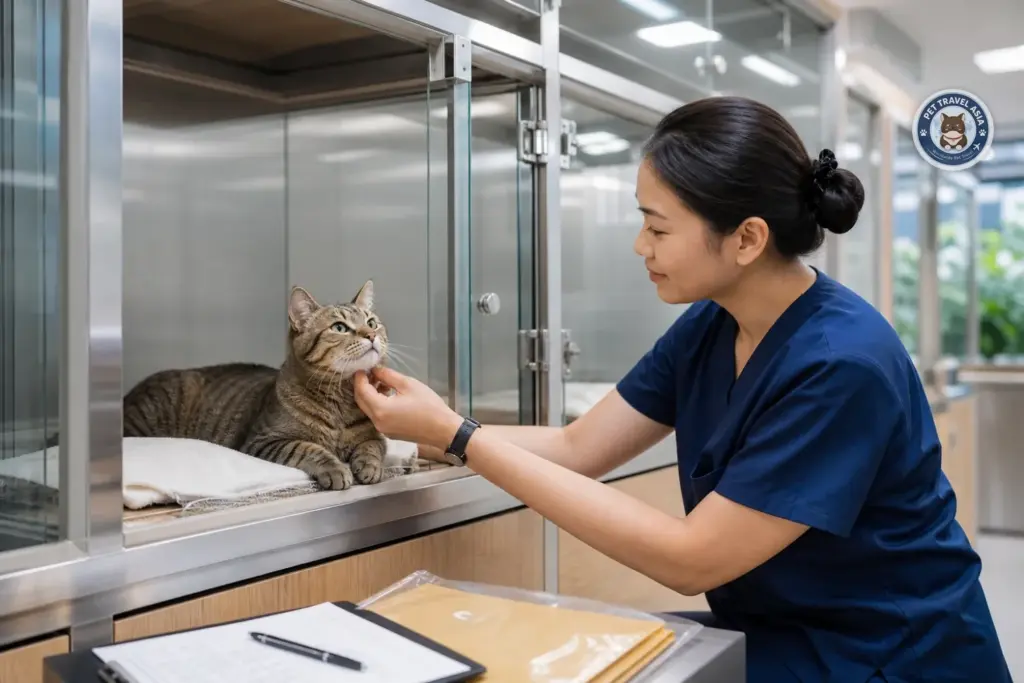
Support is particularly helpful when an import, export, or domestic movement has several handoffs. For an inbound pet, the team can coordinate the arrival sequence around government quarantine, document presentation, and release planning. For an outbound pet, it can connect the veterinarian’s timing, quarantine endorsement, crate readiness, and live-animal cargo acceptance at CGK or DPS.
It is also useful when one detail needs checking rather than guessing: a microchip number that appears differently across records, a vaccination entry that needs clarification, or a cargo date that has shifted. If you need the complete import framework first, see the Indonesia pet import requirements. For an origin-side overview, our pet export from Indonesia guide explains how the document chain is planned.
What the handling team coordinates
A quarantine handling team works as a practical coordinator between you, the veterinarian, airline or cargo operator, and the relevant government process. It does not replace an authority’s inspection or approval. Instead, it makes sure the right information reaches each stage at the appropriate time.
- Reviewing the route plan and identifying which documents, identity records, and vaccinations need to be available.
- Checking that the microchip number is consistent across the papers supplied for the movement.
- Aligning veterinary appointments, document validity windows, cargo milestones, and expected quarantine handover.
- Coordinating arrival or departure attendance, document presentation, and communication during an additional check.
- Preparing you for what to bring, where the pet is handed over, and what happens after an official release.
The detail work becomes valuable because a document can be correct in isolation but unusable if it was issued too early or is not available when cargo is accepted. Our quarantine assistance service is designed around that coordination.
Why timing is usually the vulnerable point
Most avoidable disruptions begin with dates that were planned separately. A health certificate has a validity window, a flight can be rescheduled, and a facility may need a particular handover sequence. A team maps those dependencies before departure rather than discovering a mismatch at the counter.
For pets entering Indonesia, the planning horizon is commonly several weeks; the import guidance suggests planning roughly 4–8 weeks ahead, while the final timing depends on the route and documents. Government quarantine may be under seven days when paperwork is in order, but extra verification can change the experience. For export, there is no universal release timeline: destination rules, endorsement timing, and cargo acceptance all affect the schedule.
| Travel stage | What is coordinated | Why it matters |
|---|---|---|
| Before booking is final | Route and document sequence | Prevents a flight plan from getting ahead of eligibility. |
| Veterinary preparation | Identity, vaccination, and certificate timing | Keeps records consistent and current for review. |
| Airport or facility handover | Documents, crate, cargo, and inspection readiness | Reduces last-minute uncertainty at the formal handoff. |
| After inspection | Release communication and onward collection | Helps the next step follow the authority’s decision. |
At the airport and quarantine handover
At an airport, the work is not simply dropping off a crate. The pet’s identity and paperwork may be reviewed, the crate may be checked for transport suitability, and cargo acceptance needs to match the live-animal booking. Pre-departure cargo checks for exports from Indonesia are commonly handled at CGK or DPS, with IATA crate compliance among the items that may be reviewed.
For a Jakarta-specific airport picture, read our pet cargo guide for Soekarno-Hatta. A handling coordinator can keep you informed about the handover, but the inspection outcome remains with the responsible authority. That distinction protects both your expectations and your pet’s travel plan.
What can cause an additional hold
An additional check does not automatically mean a major problem. It can arise because an original record needs to be compared, a vaccination entry needs clarification, a microchip needs to be read again, or timing has changed. The useful response is to provide accurate records promptly and avoid creating conflicting versions of the same information.
Common pressure points are incomplete documents, inconsistent microchip data, late changes to a cargo booking, and preparation that begins too close to departure. The team’s job is to flag those risks early and coordinate a response; it cannot guarantee clearance or override a requirement. Rules and timelines can change, so the latest requirements should be verified before every departure or arrival.
What remains your responsibility
You remain the owner and decision-maker. You should provide truthful, complete pet records; bring requested originals; follow veterinary advice; make the pet available at agreed times; and tell the team immediately if the flight, health status, or contact details change. You also choose whether to proceed if a route, timing, or airline policy needs to be reconsidered.
For a broader personal checklist, use the international pet relocation checklist. Good support works best when the owner and coordinator share information early, rather than treating quarantine as a last-day task.
FAQ about pet quarantine handling in Indonesia
Does a handling service replace government quarantine?
No. Government authorities conduct inspections and make release decisions. A handling team coordinates documents, timing, and handovers so you can follow that process with better preparation.
Can the team promise my pet will be released on a certain day?
No. A likely sequence can be planned, but release depends on the route, documents, inspection findings, and any additional verification required by the authority.
Is support only for pets arriving from overseas?
No. It can help with imports, exports, and some inter-island movements where quarantine requirements or cargo handoffs apply.
What should I send before asking for a plan?
Share the origin, destination, target date, species, breed, microchip and vaccination history, and any flight or cargo information you already have. The team can then confirm the current route-specific requirements.
When your travel plan involves quarantine, do not wait until the crate is packed. Talk with PTA about your route so we can coordinate the documents, airport steps, and quarantine support around your actual travel date.