Pet Relocation UK to Singapore: AVS Licence and Changi
November 4, 2026
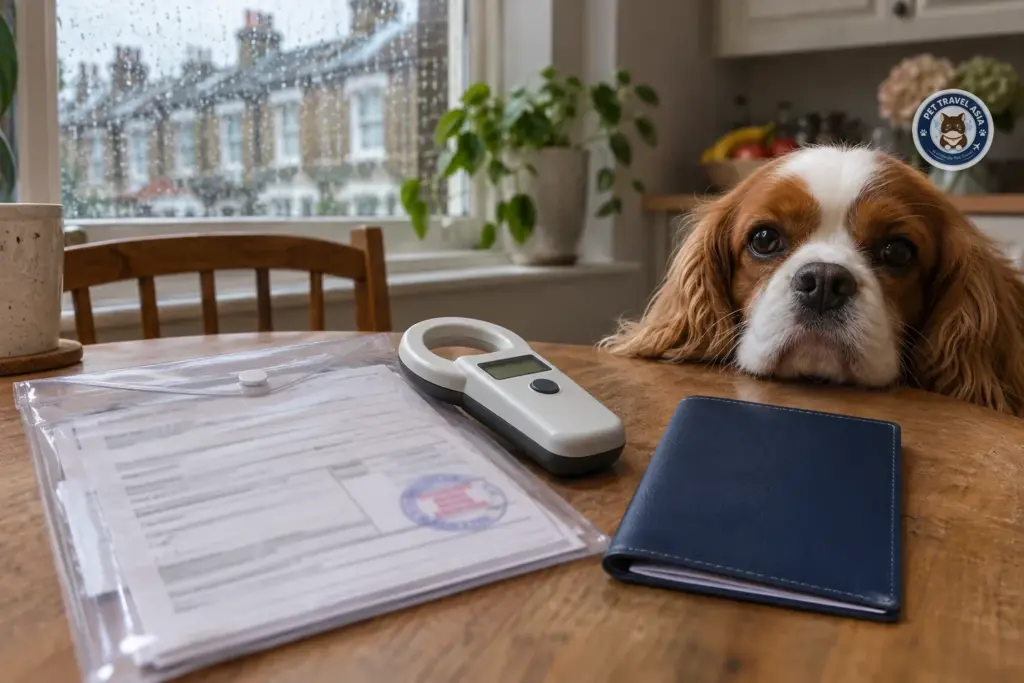
A posting to Singapore usually comes with a short runway: a start date in a few months, a flat to find, schools to sort. For owners leaving the UK, the dog or cat is often the part they expect to be hardest. In practice, the UK sits in the easiest group Singapore has, so the route is shorter than most. The catch is that it is short, not loose. Most of the work happens in the last week, and a single missed form can stop a healthy pet at Changi.
This guide is about how the UK side and the Singapore side fit together. In Singapore, the Animal and Veterinary Service (AVS), part of the National Parks Board (NParks), issues the import licence and inspects your pet on arrival. In the UK, the Animal and Plant Health Agency (APHA) handles the export health certificate, which an Official Veterinarian signs. Neither side checks the other’s paperwork for you.
Why the UK is one of the simpler origins for Singapore
Since 1 July 2024, AVS sorts origin countries into schedules by rabies risk. The United Kingdom is in Schedule I, together with Australia, New Zealand and the Republic of Ireland. Under the earlier system the same group was called Category A, and you will still see that name on UK paperwork.
For a Schedule I dog or cat, AVS currently does not ask for a rabies vaccination or a rabies blood test, and there is no quarantine on arrival as long as the animal meets every condition and is healthy at inspection. That is the real advantage of this route compared with a move from Indonesia or the Philippines, where the rabies pathway alone can take months. If you are comparing routes, our Indonesia to Singapore guide shows how different the sequence looks from a higher-risk origin.
What Schedule I does not remove: the microchip, core vaccines, parasite treatments, a vet health certificate endorsed by the UK government vet service, an import licence, an inspection booking at Changi, and the rules on breeds and housing that apply to every pet living in Singapore.
What Singapore asks for, and what the UK certificate covers
Here is how the pieces line up, based on the current AVS conditions for Schedule I and the APHA notes for certificate 7106EHC.
| Requirement | Who handles it | What to know |
|---|---|---|
| Microchip | Your UK vet | ISO 11784 or ISO 11785 Annex A. The number must appear on every vaccine and treatment record. |
| Core vaccines | Your UK vet | Dogs: distemper, adenovirus type 1, parvovirus. Cats: calicivirus, herpesvirus, panleukopenia. Must be valid on the travel date. |
| Minimum age | AVS rule | At least 12 weeks old at export. |
| Residency declaration | You, given to the OV | The UK certificate asks you to declare the pet has lived in the UK since birth, or for at least six months in the UK or another Schedule I country. |
| Parasite treatments and health certificate | Your vet, then an Official Veterinarian | Done 2 to 7 days before export. Product names, active ingredients and dates go on the certificate. |
| Pet licence and import licence | You, through AVS online systems | The pet licence comes first, then the import licence. |
| Captain’s declaration | The airline | Signed and endorsed by the carrier. AVS publishes a template. |
| Arrival inspection | AVS at Changi | Booked in advance, held at the Changi Animal and Plant Quarantine station. |
The full Singapore-side detail, including the steps that apply from any origin, is on our Singapore pet import page.
The UK side: certificate 7106EHC and the Official Veterinarian
The UK has a dedicated export health certificate for dogs and cats going to Singapore, numbered 7106EHC. In England, Scotland and Wales you apply for it through the APHA online export health certificate service. In Northern Ireland the application goes through DAERA instead.
The certificate has to be signed by an Official Veterinarian (OV), a vet authorised to certify exports. Many family practices do not have one, so ask early whether yours does or which clinic they refer to. The final appointment falls in a tight window close to the flight, and OV diaries fill up.
One thing that confuses UK owners: the APHA guidance notes for this certificate still describe the older Category A system and an import permit lead time of 30 days. AVS now issues import licences much faster and they stay valid for 90 days. Follow the current AVS conditions for Singapore’s side, and if anything on the UK certificate seems out of step, raise it with APHA before your OV signs rather than at the airport.
Licences and bookings on the Singapore side
The order matters. AVS asks you to get a dog or cat licence on its Pet Animal Licensing System (PALS) before you apply for the import licence. Mixed-breed dogs need a colour photo showing the face and body.
The import licence is valid for 90 days from issue and cannot be extended, so there is no point applying months ahead. A sensible window is once your flight is reasonably firm and your vaccines are confirmed in date. AVS lists a standard processing time of a couple of working days once documents are complete, but treat that as a best case.
Book the arrival inspection at Changi at least five days before you land, with your import licence, flight details and a contact number ready. Turning up without a booking leads to extra hourly charges and a slower release.
Housing is the other Singapore rule worth checking before you sign a lease. In an HDB flat, AVS allows one dog of an approved breed and up to two cats. Private housing allows up to three cats or dogs in total. A family moving two large dogs into an HDB flat will need a different plan.
Flights from London to Changi, and why the route matters
Direct flights operate between London Heathrow and Singapore Changi, and for a pet that is usually the simplest option. The captain’s declaration asks the airline to confirm where the pet boarded, that it was not mixed with animals from other countries, and that it stayed in its crate within the airport at any stop.
The UK guidance notes also say that a change of aircraft needs prior permission from AVS. If your itinerary connects through the Gulf or another hub, raise it with AVS and the airline before booking, not after. Whether your pet flies in the cabin, as checked baggage or as cargo depends on the airline, and our cargo, cabin and checked baggage guide explains how those options differ.
On arrival, air passengers’ pets are inspected at the Changi Animal and Plant Quarantine station at Changi Airfreight Centre. Crates larger than 82 cm long, 64 cm high and 58 cm wide have to be collected in person there. Soft carriers are not accepted for the transfer from the terminal, so a pet flying in the cabin still needs a rigid IATA-compliant crate available.
Breeds Singapore does not accept
This is the check to make before anything else, because no paperwork fixes it. AVS does not allow Pit Bull types (including the American Pit Bull Terrier, American Staffordshire Terrier, Staffordshire Bull Terrier and American Bulldog), Akita, Boerboel, Dogo Argentino, Fila Brasileiro, Neapolitan Mastiff, Tosa, Perro de Presa Canario, or crosses of these. That rules out the Staffordshire Bull Terrier, one of the most common family dogs in the UK. For cats, first to fourth generation Bengal and Savannah crosses are not accepted; later generations need documentary proof.
A working countdown for a UK to Singapore move
- Two to three months out: confirm the breed is accepted, check the microchip reads and matches every record, and bring core vaccines up to date. Find an OV.
- Six to eight weeks out: confirm the airline booking for the pet and the routing. Start the PALS pet licence.
- Once the flight is firm: apply for the AVS import licence and submit the 7106EHC application online.
- At least five days before arrival: book the Changi inspection.
- Two to seven days before departure: parasite treatments, the vet health check and the OV signature, plus the captain’s declaration arranged with the airline.
If you may move back to the UK later, check the current GOV.UK rules for bringing a pet into Great Britain from Singapore before you leave. A rabies vaccine is not needed to enter Singapore from the UK, but it is part of the return route, and keeping it current saves a scramble later. Our pet import document checklist is a useful way to keep both sets of papers in one place.
Frequently asked questions
Does a dog from the UK go into quarantine in Singapore?
Not if it meets every AVS condition for Schedule I and is healthy at the arrival inspection. If a document is missing or the pet is unwell, AVS can detain it for observation or send it back, so the paperwork matters more than the flight.
Does my pet need a rabies vaccine to fly from London to Singapore?
Under current AVS conditions, Schedule I pets do not need a rabies vaccine or blood test to enter Singapore. Many UK owners vaccinate anyway because it is needed for a later return to Great Britain. Confirm both sides before you travel, as rules can change.
How long does the whole process take?
For a healthy pet with vaccines already in date, the core paperwork can fit into a few weeks. The real limits are the OV appointment, the airline’s pet space, and housing in Singapore. Starting two to three months ahead leaves room for any of those to slip.
Can my pet transit through another country on the way?
Possibly, but it adds conditions. The captain’s declaration covers stopovers, and the UK guidance notes say a change of aircraft needs prior AVS permission. A direct London to Singapore flight avoids most of those questions.
If you would like a second pair of eyes on the UK and Singapore paperwork, our relocation services cover the import licence, OV coordination and the Changi arrival, and our Singapore relocation page explains how we work on the ground. You can tell us about your move and we will map out the order of steps for your pet.