Pet Relocation UK to Thailand: APHA Certificate to DLD Entry
November 1, 2026
A retirement near Hua Hin, a teaching post in Bangkok, a few years working remotely from Chiang Mai: Thailand is one of the most common long-stay moves for people leaving the UK, and many of them would not consider going without the dog or cat. The flight is the easy part to picture. The paperwork is where UK owners get caught, mostly because the British side runs on a certificate with a very short window and a type of vet most families have never needed before.
This guide connects the two halves of the move. On the UK side, the Animal and Plant Health Agency (APHA) issues an export health certificate that an Official Veterinarian signs. On the Thai side, the Department of Livestock Development (DLD) issues the import permit and inspects your pet on arrival. We also cover something UK owners often leave too late: what it takes to bring the pet back to Great Britain later, because Thailand is not on the easy list.
Who handles which part of a UK to Thailand move
Five different parties look at the same file, and each one only answers for its own piece.
| Step | Who handles it | What it covers |
|---|---|---|
| Import permit and entry conditions | Department of Livestock Development (Thailand) | Permission to bring the pet in and the conditions it must meet |
| Vaccines and routine records | Your usual UK vet | Microchip, rabies and other vaccines, recorded in English with clear dates |
| Export health certificate | An Official Veterinarian (OV), using the APHA certificate for Thailand | The final exam and the signed certificate that travels with the pet |
| Pet booking | The airline or its cargo team | Cabin, hold or cargo, crate rules, any connection and seasonal limits |
| Arrival inspection | Animal quarantine station at the Thai airport | Document check and a look at the pet when it lands |
For the Thai entry side from any origin, see our pet relocation to Thailand guide, the Thailand pet import overview and our Thailand relocation page. This article is about how the UK side fits around it.
The APHA certificate for Thailand and the Official Veterinarian
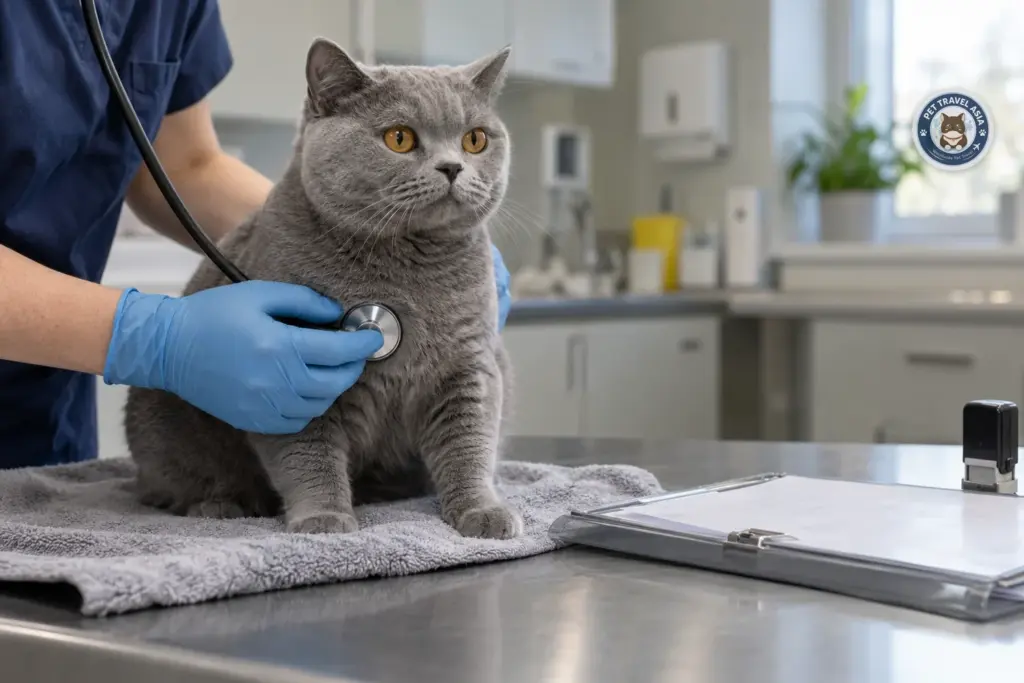
The UK has a destination-specific certificate for dogs and cats going to Thailand, known as EHC 2917, with its own notes for guidance. You apply for it through APHA, and it must be signed by an Official Veterinarian: a vet authorised by Defra (or the devolved governments) to certify exports. Your regular practice may have one, or may refer you to another clinic. Ask early, because OV appointments close to departure fill quickly.
The version of the certificate published on GOV.UK asks the OV to confirm, among other things:
- Final exam: the pet is examined not more than 72 hours before the planned export date and found fit to travel, with no signs of infectious disease or external parasites.
- Rabies: either a declaration that the pet has lived in the UK for the past six months or since birth, or a rabies vaccine given at least 21 days before departure.
- Dogs, leptospirosis: a vaccine given at least 21 days before departure, or a negative leptospirosis blood test taken within 30 days before departure.
- Dogs, other vaccines: distemper, infectious hepatitis and parvovirus, given at least 21 days before export.
- Crate: a declaration that the pet travels in an IATA-compliant container that is new or properly cleaned.
The certificate itself states that it is valid for 10 days from the date of signature. In practice, the 72-hour exam is the number that drives your calendar.
A note on rabies: even though the UK certificate allows a residency declaration instead of a vaccine, Thailand’s own entry requirements list a rabies certificate as a core document, and the vaccine is also the starting point for any later return to Great Britain. Most UK owners should vaccinate anyway, and early.
Working backwards from a 72-hour exam
A certificate that has to be signed within three days of the flight leaves almost no slack, so plan in reverse from a confirmed booking:
- Two to three months out: check that the microchip reads and matches every record, and give the rabies vaccine if it is not current. If the pet might come back to the UK later, this is also the moment to think about a rabies blood test (see below).
- Six weeks or more out: confirm the airline booking for the pet and line up the OV appointment. Ask the OV what they need from you and how they handle a reissue if the flight moves.
- At least 21 days before departure: all required vaccines are done. For dogs, decide between the leptospirosis vaccine and the 30-day blood test.
- Before the OV signs: send the Thai import permit request. Thai guidance asks for it at least 7 working days before travel and allows at least 3 working days for review. Send it as soon as the vaccine records are complete, because the permit should be in hand before the final certificate is signed.
- Within 72 hours of the flight: the OV exam and signature. Keep the signed original with the pet’s documents, plus scans on your phone.
Our pet relocation timeline guide shows how this countdown compares with other routes into Asia.
Flights from London to Bangkok, and why transit matters
Some carriers fly direct from London to Bangkok; many itineraries connect through the Gulf or another Asian hub. For the pet, that connection is not a detail. The UK guidance notes for this certificate say that if the animal is not travelling direct to Thailand, the exporter must seek approval from the Thai authorities, and the transit country may want its own permission or health paperwork. A direct flight usually means one less set of rules to satisfy.
Each airline also sets its own rules on cabin pets, pets in the hold and cargo. Confirm every leg, the crate size and any summer heat restrictions before you pay for your own ticket. If you have a snub-nosed breed, ask specifically, because many carriers restrict brachycephalic dogs and cats in the hold. Our IATA crate guide covers sizing so the crate is accepted at check-in.
What to expect when you land in Thailand
At the arrival airport, the animal quarantine station checks the import permit and certificate against your pet and its microchip. PTA’s Thailand overview describes no quarantine for pets that fully meet the requirements. One caution for UK owners: the APHA guidance notes for this certificate still mention a post-arrival quarantine of at least 30 days at approved premises. We read that as historical wording, but it is exactly the kind of mismatch to clear up with DLD before you fly, so that the conditions on your permit are the ones you plan around.
Most problems at arrival are small and preventable: a microchip number with one digit wrong, a vaccine date missing, or a certificate signed for a different flight date. Each of these is far easier to fix in the UK than in Bangkok.
If your pet may return to the UK
Plenty of moves to Thailand are for a fixed contract, so plan the return before you leave. Great Britain sorts countries into listed and unlisted, and at the time of writing Thailand is not one of the listed countries (check the current GOV.UK list before you rely on this). For a pet entering Great Britain from an unlisted country, GOV.UK sets out these steps:
- A microchip, implanted before the rabies vaccine.
- A rabies vaccine, followed by a rabies blood test taken at least 30 days after vaccination, with a result of at least 0.5 IU/ml.
- A wait of 3 months from the date of the blood sample before the pet can enter Great Britain.
- For dogs, a tapeworm treatment given between 24 hours and 5 days before arrival.
- An accepted pet travel document and an approved travel route into Great Britain.
A pet that does not meet the rules can be placed in quarantine for up to 4 months at the owner’s cost. GOV.UK also describes cases where a blood test done before leaving means the 3-month wait does not apply on return. Ask your UK vet whether that applies to your pet, and if it does, doing the test before the move can save months later. Our rabies titer guide explains how the test works.
Frequently asked questions
Can my normal vet sign the export certificate for Thailand?
Only if they are an Official Veterinarian authorised to sign export certificates. Your usual vet can handle the vaccines and records, and many practices have an OV or can refer you to one.
Does my pet need a rabies vaccine if it has always lived in the UK?
The UK certificate allows a residency declaration, but Thailand lists a rabies certificate among its core entry documents, and you will need the vaccine to bring the pet back to Great Britain. Confirm the current Thai conditions with DLD and vaccinate in good time.
How far ahead should I start?
Two to three months is a comfortable start for most UK to Thailand moves, longer if you want the rabies blood test done before you leave. The tight part is the final 72 hours, so the earlier steps need to be finished well before then.
Will my pet be quarantined in Thailand?
PTA’s Thailand overview describes no quarantine for pets that fully meet the requirements, but the UK guidance notes for the export certificate mention a quarantine period. Ask DLD to confirm what applies to your permit and arrival date.
Planning your move
If you would like help lining up the OV appointment, the Thai permit and the flight so they fit the same week, see how our relocation service works, get a starting estimate with the cost calculator, or contact our team with your travel date and your pet’s details.