Importing Cats to Vietnam: Documents, Cabin and Carriers
November 21, 2026
If you plan to import a cat to Vietnam, the paperwork is the easier half. Vietnam’s quarantine rules for animals carried by passengers do not separate cats from dogs, so a healthy, vaccinated cat with a valid certificate from its departure country follows the same short procedure at the airport. What makes a cat move different is the journey: whether your cat can stay with you in the cabin, the size of the carrier, how airlines treat Persians and other flat-faced breeds, and how a cat copes with a long transit into Hanoi or Ho Chi Minh City.
The rules sit in Circular 01/2026/TT-BNNMT, in force since 1 January 2026. Our guide to importing dogs to Vietnam walks through the circular in detail. This guide summarises what matters for a cat and spends most of its time on the travel decisions. It leaves out fees, which depend on your route and airline.
What Vietnam’s rules say about a pet cat
Article 14 of the circular covers a person bringing in no more than two animals to keep as pets, for family life, or on a trip for tourism, work or transit, as long as the species is not on Vietnam’s banned list. A domestic cat fits that description. The owner declares the cat directly at the animal quarantine office at the port of entry, without an advance registration.
At the airport the office checks the veterinary certificate from the exporting country and examines the cat. It can vaccinate an animal that has not been vaccinated against dangerous infectious diseases, and take samples if it suspects disease. If no samples are needed and the file is complete, the office issues an import quarantine certificate within one working day of the check. If samples are taken, the limit is five working days and the result has to be negative.
Three or more cats, or a shipment that falls outside that description, follow a longer route: registration with the veterinary authority before import, a declaration to the port office before arrival, and an isolation location arranged by the owner. The dog guide covers that route step by step.
The documents to prepare for your cat
The document Vietnam names is the veterinary certificate issued by the exporting country, so its format comes from your own government veterinary service. The United States uses one certificate for both dogs and cats going to Vietnam. It lists a microchip number for each animal as required, asks the vet to confirm the animals are healthy and current on rabies vaccination at export, and is valid for 30 days from issue to departure. Other countries use their own versions.
Article 14 asks for a healthy, vaccinated animal but does not list vaccines or timings. For planning we work to a stricter standard that most exporting authorities and airlines accept: an ISO microchip implanted before the rabies vaccine, and the rabies vaccine given at least 30 days before arrival. Ask your vet whether your cat’s routine core vaccines are also current and recorded clearly, since older records often list only a brand name or a lapsed booster.
| Item | Who handles it | What to watch for a cat |
|---|---|---|
| Microchip | Your vet at origin | Reads cleanly and matches the number on every document |
| Rabies vaccine | Your vet at origin | Given after the microchip, recorded with dates in English |
| Veterinary certificate | Veterinary authority of the exporting country | Issued within its validity window before departure |
| Airline booking | The airline | Cabin, checked baggage or cargo, carrier size, breed limits |
| Arrival declaration | You, at the airport quarantine office | Originals carried in hand luggage |
Our Vietnam import overview and Vietnam relocation page show how these steps fit into the wider move.
Cabin, checked baggage or cargo
Many cats are small enough to be considered for the cabin, which is often the calmer option for an animal that dislikes being out of sight. Whether it is allowed depends on the airline, the route and the combined weight of cat and carrier, and some airlines do not take pets in the cabin on international flights at all. Treat the cabin as a question to ask when you first price flights, not an assumption. Our guide to cargo, cabin and checked baggage explains the three options.
The circular is written around animals carried by the passenger. It does not spell out how it treats a cat flying as cargo on a different flight from its owner. If that is your plan, ask the quarantine office at the arrival airport which procedure applies before you book.
Choosing and getting used to the carrier
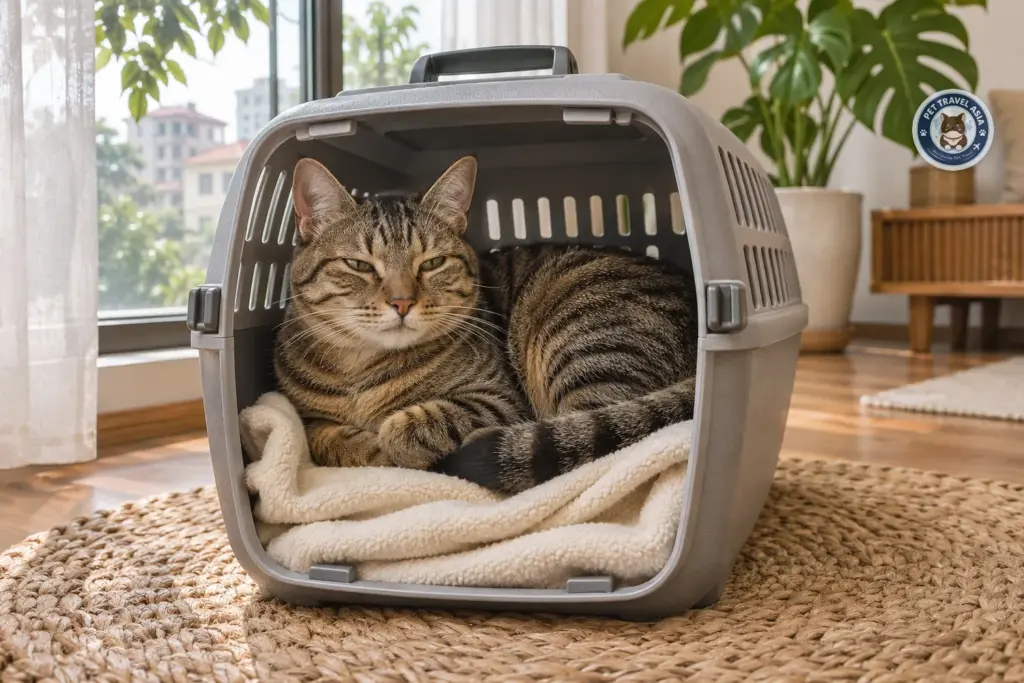
A cabin carrier has to fit the airline’s under-seat dimensions, which differ between carriers and aircraft. A cat travelling in the hold needs a rigid kennel that meets IATA rules, with enough room to stand, turn and lie down. Our IATA crate guide covers sizing and the details airlines check at acceptance.
Leave the carrier open at home for several weeks, with familiar bedding inside, so your cat treats it as a normal resting place before the flight. A cat that already sleeps in its carrier is far easier to load at the airport, and less likely to panic during inspection on arrival.
Persian, Exotic and other flat-faced cats
The circular does not single out cat breeds. The limits come from airlines. Flat-faced cats such as Persians, Exotic Shorthairs and Himalayans breathe less efficiently, so some carriers refuse them in the hold, restrict them in hot months, or accept them only in the cabin. Southern Vietnam is hot all year, which makes that question more pressing on routes into Ho Chi Minh City.
For these cats, find an airline that will accept your cat on the exact route first, then build the vaccine and certificate timing around that flight. Our guide to flying snub-nosed pets in Asia explains what to ask.
Long transit and arrival in Hanoi or Ho Chi Minh City
Most pets arrive at Noi Bai (HAN) in Hanoi or Tan Son Nhat (SGN) in Ho Chi Minh City. The declaration and inspection happen at the airport where your cat first enters Vietnam, so choose it with your final address in mind. A domestic connection after a long international flight adds another day of handling for a cat that is already tired.
A cat’s biggest risk on a long trip is usually stress, not paperwork. Pick the shortest routing you reasonably can, avoid tight connections, line the carrier with an absorbent pad and pack a spare. Ask your vet about any calming product before travel; sedation is generally discouraged for flying, especially for flat-faced cats. Our pet travel kit guide has a fuller list. On arrival, keep the certificate, vaccination record and your passport together in hand luggage so the quarantine officer can check them quickly.
Frequently asked questions
Do I need an import permit to bring one cat to Vietnam?
Article 14 of the circular does not require advance registration for a person bringing up to two pet animals. You declare the cat at the animal quarantine office on arrival. Your airline may still ask for its own paperwork, so check with it.
Will my cat be quarantined in Vietnam?
A healthy, vaccinated cat with a valid certificate is normally cleared at the airport, with the quarantine certificate issued within one working day of the check. A cat that needs testing, or that arrives with invalid documents, can be held while the case is handled.
Can my cat fly in the cabin to Vietnam?
Often, but not on every airline or route. It depends on the carrier’s policy and the weight of cat plus carrier. Confirm with the airline before you book.
Can I bring a Persian cat to Vietnam?
The circular does not ban cat breeds, but airlines often limit flat-faced cats, especially in the hold and in hot months. Secure a flight that accepts your cat first.
Planning to bring your cat to Vietnam? Send us your route, travel month and your cat’s breed and weight, and we will tell you what to prepare first and whether the cabin is realistic on your route.