Flying Snub-Nosed Pets in Asia: Pugs, Frenchies, Persians
November 14, 2026
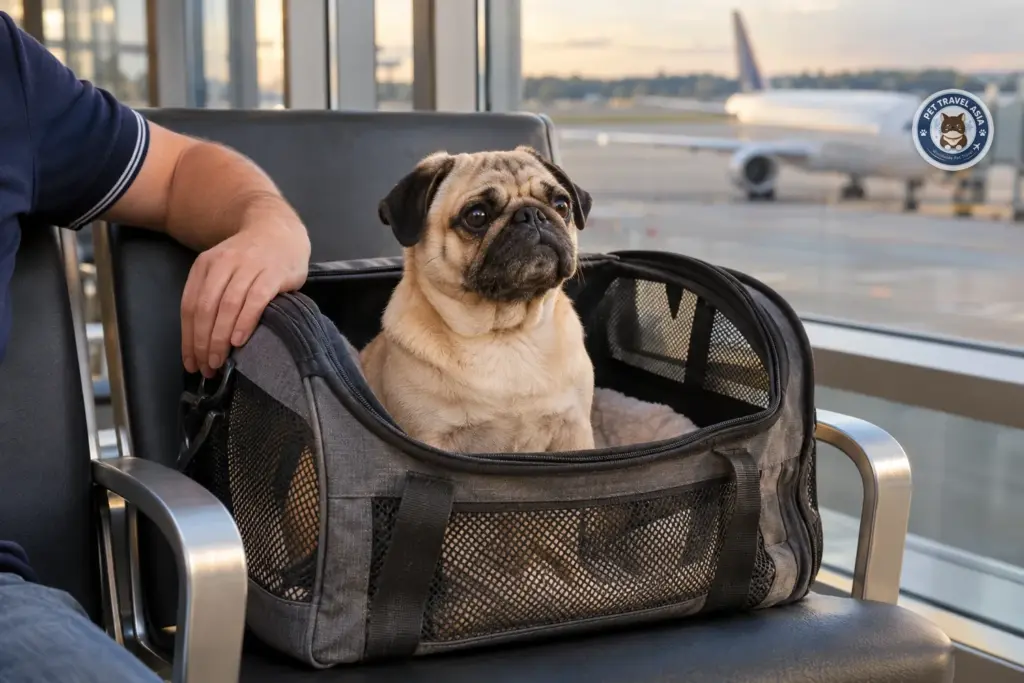
Flying a snub-nosed pet is less about the pet’s paperwork and more about finding an airline that will take it at all. A healthy Pug can be refused on one carrier, accepted only in certain months on another, and welcomed in the cabin on a third. Persian cats get caught by the same rules, which surprises owners who assume breed restrictions are a dog problem.
This guide looks across breeds and airlines. It explains why carriers limit flat-faced animals, shows what several airlines serving Asia actually publish, and sets out the options left when your first choice says no. If you have a French Bulldog and are mainly weighing up the cabin, our French Bulldog cabin guide goes deeper on carrier and weight questions.
Why airlines restrict flat-faced pets
Brachycephalic animals have shortened skulls, and with them a shorter, tighter airway. Dogs in particular shed heat by panting, so a narrow airway makes both breathing and cooling harder, and flat-faced cats face similar breathing limits. Cathay Pacific describes the issue plainly on its travel page: an increased risk of respiratory difficulties and heat intolerance during air travel.
The flight itself is only part of it. The harder moments are often on the ground: waiting on a warm apron, sitting in a crate through a long transit, or arriving in Bangkok or Manila in the middle of a hot afternoon. Stress raises breathing effort at the same time. That is why airlines tend to write rules for the whole breed rather than judge each pet on the day, even one that seems perfectly fit at home.
Breeds that usually count as snub-nosed
There is no single worldwide list. Each airline writes its own, and the lists are often longer than owners expect. They commonly cover:
- Dogs: Pug, French Bulldog, English Bulldog, Boston Terrier, Boxer, Shih Tzu, Pekingese, Lhasa Apso, Japanese Chin, Brussels Griffon, Shar-Pei and Cavalier King Charles Spaniel.
- Cats: Persian, Himalayan, Exotic Shorthair, and on some lists British Shorthair, Burmese and Scottish Fold.
- Mixed breeds: a cross with a listed breed can count too. Singapore Airlines and Korean Air both say so, so a Pug mix does not automatically get around the rule.
If your pet is a mix or the breed is unclear on its records, raise that with the airline early. Finding out at check-in leaves you with no options.
What airlines serving Asia publish
These examples come from airline pages we read in November 2026. They show how far policies differ, and they can change, so treat them as a reason to ask rather than as your answer.
| Airline | What it says | What it means for planning |
|---|---|---|
| Singapore Airlines | Will not carry a listed set of breeds as checked baggage, including French and English Bulldogs, Pugs, Shih Tzu, Persian, Himalayan and British Shorthair, plus crossbreeds and other brachycephalic breeds | Read the full list before planning around SQ. It also includes some breeds that are not flat-faced |
| Cathay Pacific / Cathay Cargo | Accepts certain brachycephalic breeds from January to May and October to December on Hong Kong to London Heathrow, Melbourne and Singapore, through an IPATA-certified snub-nosed pet shipper. Pets otherwise travel through Cathay Cargo; assistance dogs may be on board | A narrow window: the month, the route and the shipper all have to fit |
| Korean Air | Snub-nosed breeds, including mixes, cannot travel in the cargo hold | Ask about cabin eligibility instead, since the hold is not an option |
| Thai Airways | As a general policy, does not accept pets in the cabin apart from its listed exceptions | On carriers like this, a cabin plan needs a different airline |
Notice the pattern. A hold ban on one airline and a cabin ban on another can leave a flat-faced pet with no direct option on a popular route, so the airline often has to be chosen first and the route built around it. Our guide to cargo, cabin and checked baggage explains how those three booking types differ.
The options when the first airline says no
Cabin travel with you. Where an airline allows pets in the cabin and your pet fits its size and weight limit, this keeps your pet with you for the whole flight. Many Asian carriers do not offer it, and larger breeds such as English Bulldogs often exceed the limit, so check the published figure on your specific flight.
Cabin travel with an escort. If you cannot fly the route yourself, or the workable routing is not one you would otherwise take, a dedicated escort can hold a ticket on the same aircraft with your pet in an approved carrier under the seat. Our VIP escort service works this way, including a recent French Bulldog journey in the cabin from Jakarta to Dubai. It depends on your pet’s profile and airline approval for every leg, so we confirm availability before anything is booked.
A restricted cargo window. Some carriers still accept certain breeds in cooler months on set routes, as the Cathay example shows. Expect conditions, including specialist shippers and paperwork, and talk to your vet honestly about whether your pet is a good candidate.
A different route or timing. A short routing with fewer connections, or a move in a cooler month, can open options that a hot-season departure does not. Sometimes the best answer is to move the date, which is easier if you start early. Our relocation timeline guide shows how far ahead the steps need to begin.
How to prepare a flat-faced pet
- See your vet first, before booking. Ask for an airway and fitness assessment, and ask directly whether your pet should fly. Some airlines or shippers may want a written fitness statement.
- Do not sedate. Singapore Airlines tells owners not to give sedatives or tranquilisers before a flight, and sedation is a particular concern for a pet with a narrow airway. Discuss anxiety with your vet and use carrier training at home instead.
- Size the carrier or crate generously within the rules. Your pet needs room to stand, turn and lie down with good airflow. Some airlines set extra crate conditions for these breeds, so ask before you buy. Our IATA crate guide covers the basics.
- Plan around heat. Choose morning or evening departures and arrivals where the schedule allows, and avoid long daytime transits. This matters most in tropical hubs.
- Keep weight healthy. Extra weight adds to breathing effort, and it can also push a pet over a cabin limit. Ask your vet what is realistic before travel, without crash dieting.
Entry rules still apply on top of all this. Airline approval does not replace the destination’s permit, vaccination or quarantine requirements. For the six countries we focus on, start with the country page, for example Singapore or Thailand, and see our note on dogs entering Thailand for how breed questions come up there.
Frequently asked questions
Can a Pug fly at all?
Often yes, but not on every airline or in every month. Some carriers refuse Pugs entirely on the booking type you want, while others allow them in the cabin or in limited cargo windows. Start from the airline’s current breed list, then build the route.
Do these rules apply to Persian cats?
Yes, on many airlines. Singapore Airlines lists Persian and Himalayan cats among the breeds it will not carry as checked baggage. A calm cat that travels well is still covered, because the rule is written around the breed.
Is my mixed breed exempt?
Do not assume so. Some airlines explicitly include crossbreeds of listed breeds. Share your pet’s records and photos with the airline and ask for a written answer.
Does an escort guarantee my pet can fly?
No. An escort solves the question of who sits with your pet, but the airline still decides on cabin acceptance for that flight. Route, carrier size, your pet’s profile and the destination’s rules all have to line up.
Which months work best?
Airlines that allow restricted carriage tend to favour cooler months, though the months are set per airline and route. In tropical Asia the heat lasts all year, so time of day and transit length still matter. Your vet and the airline should both weigh in.
Flat-faced pets take more planning, and the answer depends heavily on your route. Tell us your pet’s breed, age and weight along with your dates, and our team can look at which airlines and routes are worth pursuing before you commit to a ticket.