Ship a Cat Internationally From Indonesia
July 27, 2026
Moving abroad with a cat can feel harder than the paperwork alone suggests. A cat that is relaxed at home may become unsettled by an unfamiliar crate, airport sounds, and a new scent landscape. Good preparation gives your cat a familiar routine to hold on to while the travel plan is being arranged.
If you need to ship a cat internationally from Indonesia, start with the cat’s readiness as well as the destination requirements. The document chain matters, but a calm crate routine, a realistic airline check, and a gentle landing plan are the parts owners can influence early.
Why travelling with a cat is different
Cats are strongly attached to territory. A move replaces their familiar room, feeding spot, and scent map all at once, so the goal is not to make travel seem exciting; it is to make each stage predictable. This is why a crate should become a safe resting place before it becomes transport equipment.
The export documentation pathway is broadly similar for cats and dogs, but its order is crucial. Read the Indonesia pet export guide for the wider document sequence. Microchip records, vaccinations, any destination-required testing, health certificates, and Indonesian quarantine documentation must line up with the intended flight date. Requirements and validity windows can change, so confirm them for your route and departure date.
Make the crate familiar weeks before travel
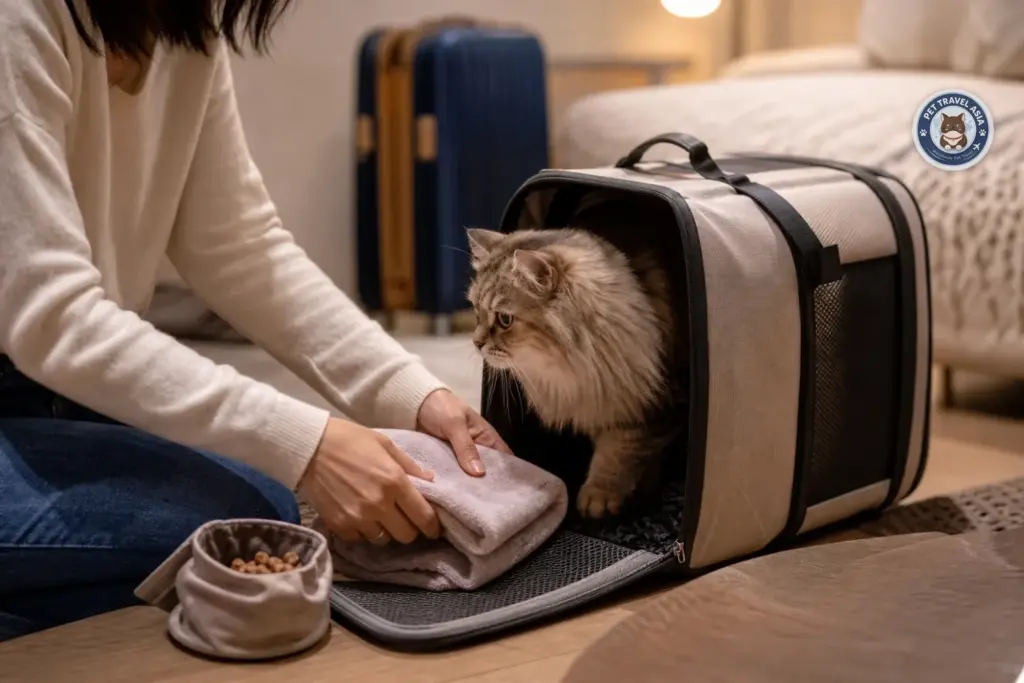
Do not introduce the travel crate for the first time on departure day. Place it open in a quiet part of the home, add a washable item with familiar scent, and let your cat choose to investigate. Start with treats or meals near the entrance, then inside it. Build up to brief periods with the door closed only when your cat is already comfortable resting there.
For the crate itself, your cat should be able to stand, turn around, and lie down naturally. The detailed construction and sizing rules are covered in our IATA crate guide. Keep the training focus here on calm repetition: short sessions, an unchanged cue, and no chasing or forcing the cat inside.
| Preparation point | Cat-focused priority |
|---|---|
| About 6–8 weeks before | Start crate acclimatisation and review the destination pathway. |
| Several weeks before | Practise quiet crate rests and keep vet/document appointments in sequence. |
| Departure week | Keep routine stable; pack familiar food, absorbent pads, and document copies. |
| Travel day | Use a calm handover and follow the feeding plan agreed with the vet and travel team. |
| After arrival | Begin in one prepared room with water, litter, food, and a familiar item. |
Cabin, cargo, and flat-faced cats
Whether a cat can travel in cabin or needs an air-cargo arrangement depends on the airline, aircraft, route, season, and the individual booking. It is not simply an owner preference. Carrier dimensions and acceptance policies vary, so they must be checked directly for the chosen flight.
Persian, Himalayan, and Exotic Shorthair cats need an earlier airline review because flat facial anatomy can make temperature control and breathing less efficient. The same risk principles are explained in our guide to flying with brachycephalic pets. Airline policies can change, and acceptance should never be assumed from a previous trip.
Health and documents: sequence beats speed
For many international moves, the sequence begins with a readable microchip, followed by rabies vaccination and other destination steps. Some destinations also require a rabies titer test and a waiting period; these rules differ by country. Japan is one example of a stricter corridor, so use our Indonesia-to-Japan cat guide only when that destination applies.
A common avoidable problem is having a document issued too early, then discovering it is no longer valid when the cat flies. Keep the microchip number identical across every record, avoid locking a cargo booking before the route has been reviewed, and ask the team to map the appointments backward from departure.
Travel-day essentials for cats
Travel day should be deliberately quiet. Pack original documents and copies in a water-resistant sleeve in your cabin bag, plus familiar food in a sealed labelled pack, a collapsible bowl, a small water bottle, absorbent pads, wipes, and a comforting item that smells like home. Our pet travel kit checklist helps with the wider packing list.
- Confirm the handover time and feeding plan before leaving home.
- Use an absorbent crate lining and bring spare pads for the journey.
- Keep litter available until the point where the handling instructions say otherwise.
- Do not make last-minute changes to food or routine.
Sedation is generally not recommended for air travel. Any decision about a cat’s health or medication belongs with the veterinarian who examines your cat directly.
Let your cat decompress after arrival
Prepare one quiet room before your cat arrives: litter tray, water, familiar food, a bed or blanket, and a hiding place. Let your cat come out at its own pace rather than opening the whole home immediately. Hiding, reduced appetite, or watching from a safe corner can be normal for the first few days; persistent concerns should be discussed with a local veterinarian.
FAQ: sending a cat abroad from Indonesia
How early should I start?
For a simpler route, begin around 6–8 weeks before travel. Start much earlier when the destination needs permits, a titer test, a waiting period, or quarantine planning. A route review confirms the right lead time.
Will my cat have to quarantine?
It depends on the origin, destination, health status, and documents. Indonesia’s animal-quarantine process is overseen by Badan Karantina Indonesia, while destination rules vary. Confirm the current requirement for your individual route.
Can a Persian cat fly?
Some flat-faced cats can travel, but airline acceptance and safe routing need an early case-by-case review. Do not assume cargo or cabin acceptance without confirmation for the flight date.
Can my cat travel in the cabin with me?
Possibly, if the airline accepts the cat, carrier, route, and booking. Policies differ by airline and aircraft, so this needs to be checked before tickets are finalised.
For a calmer plan, contact Pet Travel Asia with your origin, destination, cat’s breed, and preferred travel date. Our team can review the route, document sequence, airline handling options, and the preparation steps that suit your cat.